Archive

Archive for the ‘Motorman’s Mean Streets’ Category

Motorman at Daytona Bike Week

March 7th, 2011 No comments

Broken Spoke Saloon

Jerry and his team will be at the Broken Spoke Saloon on Friday afternoon, March 11, 2011 along with American Bagger Magazine for a meet and greet!  Stop by and say hello to Motorman and his team of riders!

ROAR Motorcycles

897 Bellevue Avenue, Daytona Beach, FL  32114

Show Times: Saturday, March 12th between noon and 3 pm

http://www.roarmotorcycles.com/


The Ride Like a Pro Team

www.ridelikeapro.com


Motorman’s mean Streets 01-11

January 5th, 2011 No comments

In the last issue, I wrote quite an extensive article about making turns from a stop. While turning from a stop may seem like a rather mundane topic – from what I’ve seen, more than half the ‘experienced’ riders have not mastered the stop and turn.

You may not believe this but the day after writing that article, I witnessed a stop and turn crash one block from my home. Here’s what happened. As I pulled onto my street I saw two riders coming down their driveway. The street is one lane, separated from the other lane by an island, so they must turn right out of the driveway. The first rider pulled right out but the second rider was duck walking the bike down the drive and made a complete stop. Though the rider had a full face helmet on and full gear, I could tell it was a woman and she appeared a little tentative. The bike she was on was a sport bike with a custom stretched wheelbase. Since sport bike handlebars don’t turn very far, stretching the wheelbase makes them even more difficult to turn at low speeds.

I slowed up and waved her on. I could hear her revving the motor a little too much for a smooth take off and thought, “this doesn’t look good.” She was looking to the right where she wanted to go, but she popped the clutch out too fast. As the bike lunged forward she turned her head straight, looking at the palm tree in the island where she was headed. Sure enough, she went up and over the curb and smashed right into the palm tree at 10 or 15 mph. The rear of the bike went up in the air at impact and the rider was thrown up and into the tree. It looked like she hit the tree with her shoulder.

I pulled over and as I got to her, she was laying on her back on the ground not moving. The first rider, who I assume was her husband, had now returned to the scene. I leaned down and gently opened the visor on her helmet. She looked up at me and started to lift her head but I told her in a calm voice to stay still for a few moments. I figured she might be in shock and staying calm while talking to her would keep her from panicking.

I told her not to move, but tell me what part of her body hurt. She thought for a second then said her shins. Her pants weren’t torn and no signs of blood anywhere. She insisted that she wanted to get up, so I had her first move all her limbs very slowly starting from the fingers. I said, “If you feel any pain stop moving.” She moved everything without pain, luckily. Before I let her move her head at all I made sure she felt no pain in that area. Luckily, the only injuries she had were some bruising on her shins. I’m guessing she hit the fairing lowers or the handlebars with her shins as she went up and over the bike. The bike was severely damaged if not totaled.

What’s the point? Learn how to master that clutch and throttle. How can you tell if you’ve mastered the clutch and throttle? That’s easy. Turn your bars full lock and take off from a full stop without duck walking the bike or straightening out the handlebars until you’ve made a complete 90 degree turn. If you can’t do that, you need some practice. It could save you from a serious crash or an embarrassing tip over.

If you’re ever involved in a crash, you should know the dos and don’ts. First, try to stay calm. Take a few deep breaths. Your first instinct will be to try to get up. Don’t do it! Try moving your fingers and toes, then your ankles, knees, etc. Move them very slowly and carefully; stop if you feel pain. Do not remove your helmet until you’re sure you have no neck or back injuries. Do not attempt to get up if you’re injured unless of course, staying where you are, such as the middle of a dark street could cause you to be run over. The bottom line, know what to do in an emergency situation before the emergency.

Copyright 2011 Jerry “Motorman” Palladino
www.ridelikeapro.com

Motormans mean Streets

September 9th, 2010 No comments

Will these techniques work on a Sport Bike?

Here’s a question I get quite often. “Will these three motor officer techniques you show on your Ride Like a Pro videos work on a Sport Bike?” Then there’s the same questions except instead of a Sport Bike, the question refers to Scooters.

Before I go any further and not to keep you in suspense, the answer of course is YES. As I state in both my videos and in my Ride Like a Pro Book, the three motor officer techniques work on all two-wheeled vehicles.

In case you happen to be a new reader to the column, the three motor officer techniques I’m speaking of are; the proper use of your head and eyes, the proper use of the friction zone and the proper use of the rear brake. Once these techniques are mastered, and they can be mastered in as little as four hours, any rider, male or female, big or small, can handle even the heaviest motorcycle with the ease of a child’s toy.

While most of the demonstrations I show in my video and book are performed on big touring cruisers, I also show the exercises being performed on a few Sport Bikes as well. The reason I use heavyweight cruisers is because that type of bike is 70% of the market here in the USA … plus, due to the weight of the cruiser style motorcycle, a low speed tip over is more likely to occur. Of course a Sport Bike can tip over at low speeds just as quickly as a cruiser, but because they weigh less than half of what a cruiser weighs, most Sport Bike riders can hold the bike up should it start to go down.

I’ve had quite a few people tell me they’ve mastered the techniques on their cruisers but recently purchased a Sport Bike as a second motorcycle and are now having a difficult time with U-turns, etc.  Here’s the reason for that situation. First, whenever a person gets on a new motorcycle, they tend to revert to their instincts. What that means is they are looking down and or at the very thing they don’t want to hit. While attempting a U-turn, if they look at the opposite curb, their hands follow their eyes and they will steer right towards the curb. If they don’t realize their mistake, they tend to think the new Sport Bike has a much bigger turning radius than the cruiser.

Another thing to consider is the handlebars on most Sport Bikes don’t turn as far as the cruiser handlebars. The good news is the Sport Bike has a superior lean angle to the cruiser. Remember, the further you lean the bike, the tighter the turn you can make. In addition, Sport Bikes also have a much lighter flywheel. That causes the throttle to be much more sensitive than the typical throttle response of a V-twin cruiser. To overcome that sensitive throttle, use 2nd gear when making tight, low speed turns. Using 2nd gear will allow

you to slip the clutch with much more control.

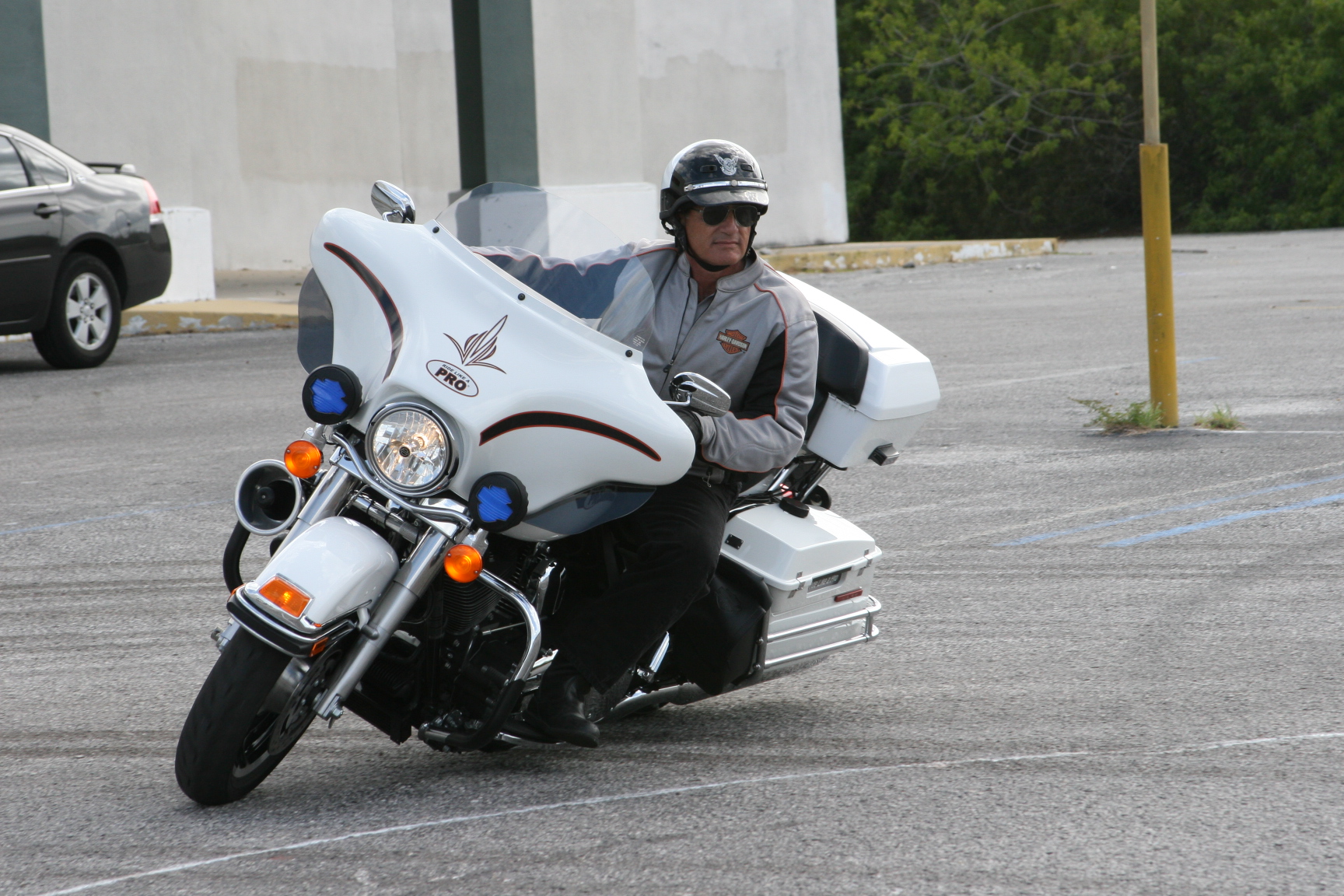
The bottom line, the three techniques work just as well on a Sport Bike as a cruiser. We had a Ducati rider and a Kawasaki Z1000 rider at our last Ride Like a Pro class (see attached pictures of these riders in this article) and we took some video of them going through the most difficult exercises. If there’s any doubt in your mind about the techniques working just as well on Sport Bikes, go to YouTube and type in Ducati_Rider_Sal or Kawasaki_Tony_intersection Ride Like a Pro and put your doubts to rest.

While I don’t have video of motor scooters running through my course, take my word for it, the techniques work just as well on the Scooter.  Believe me when I say the size and strength of the rider means nothing, nor does the type of bike you ride. It’s all technique. Learn the three techniques and you can ride anything with two-wheels like a PRO.

Copyright 2010 Jerry “Motorman” Palladino

Ride Like a Pro, Inc.

Motorman’s Mean Streets 08-10

August 6th, 2010 No comments

I get lots of email from the readers of this column as well as from people that have purchased my Ride Like a Pro video and Book. Here’s a question I get almost daily in spite of the fact that I answer it several times in my videos, book and safety tips … here it is one more time.

Motorman,

Will riding in the friction zone burn out my clutch? When I learned to drive a standard shift car, my father told me to never ride the clutch.

Answer:  If you follow my simple instructions, you won’t have a problem. First, you should know the vast majority of motorcycles are equipped with what is called a wet clutch. In other words, the clutch plates are lubricated by oil to keep them cool. There are a few motorcycles such as a few BMW’s and Ducati’s which have a dry clutch like a car. That means their clutches are not lubricated with oil so extra care must be taken. Here’s how to insure a long life for your clutch while practicing proper riding techniques.

While in the friction zone, keep your revs at about twice idle speed. In other words, don’t rev your motor to 3, 4 or 5 thousand rpms as that will surely burn your clutch out very quickly. When dragging the rear brake to help stabilize the motorcycle, use light pressure. Light pressure means about 3 to 4 lbs. To get an idea of what 3 to 4 lbs of pressure is, put the ball of your foot on the bathroom scale while keeping your heel on the ground and press down till it registers 3 to 4 lbs. Remember, the better you get with your clutch and throttle, the less pressure you’ll need on the rear brake. Lastly, after every five minutes or so of practice, breeze out the bike by cruising around the practice area in 2nd gear, out of the friction zone and no pressure on the rear brake. You can even let the bike sit for another five minutes so you can be absolutely sure the clutch plates have cooled. The worse thing you can do is run through an exercise for 20, 30, 40 minutes straight without a cool down period, especially in hot weather. If you follow these simple rules, you should get 100,000 miles out of your clutch.

Copyright 2010 Jerry Motorman Palladino

MEAN STREETS: Q & A with Motorman

July 12th, 2010 No comments

I get lots of e-mail from the readers of this column and from people that have purchased my Ride Like a Pro video and Book. Here are a few questions as well as my answers to them that may be of some interest to you.
______________________________________________

Motorman,

I have a Gold Wing 1500 which weighs 800 lbs. I feel like I’m muscle-ing it around at low speeds. I think I’m leaning enough when making turns but maybe not because I’m so tired after my practice. Should I be this tired after two hours of practicing my low speed skills?

"Tense Shoulder While Turning"

"Tense Shoulder While Turning"

correct-posture-while-turning

correct-posture-while-turning

Answer: I’m betting the reason you’re getting tired out so quickly is because you’re tensing up. I see this many times at my classes. The rider’s arms are stiff and they have a death grip on the handlebars. When making turns, I notice in whatever direction the bike is leaning, they’ll have their shoulder on that side jammed all the way up. All these things cause fatigue in a short amount of time.  When using the techniques properly, you shouldn’t feel any muscle fatigue at all and you won’t if you simply relax. You might start by sitting on your bike, shaking out your arms and your hands, roll your head from side to side then put both hands on the grips, grab the controls lightly, and make sure your elbows are bent. Next, close your eyes and visualize yourself running through whatever exercise you’re working on, in a smooth, graceful manner. In your mind, feel the bike lean from side to side. Now, open your eyes, take a few deep breaths and cruise through the exercise.

Copyright 2010 Jerry Motorman Palladino

Categories: Motorman's Mean Streets Tags:

Failure to Negotiate a Curve:

June 8th, 2010 No comments

Motorman’s Tips, tricks, and Techniques

Failure to Negotiate a Curve:

I know I’ve discussed this type of incident before, but I feel compelled to go over it once again since it happens so often. Here are the circumstances of the failure to negotiate a curve I have witnessed.

I was 5th in a staggered group of 8 riders. We were cruising down the Ozello Trail in Homosassa at a leisurely pace. If you’re not familiar with the Ozello Trail, it’s a winding two lane road which winds for five or six miles from U.S. 19 to the Gulf of Mexico. On both sides of the road there’s a grassy, soft shoulder about six feet wide that dips into the narrow Homosassa River. Most of the turns can be taken at 40mph, but our pace was closer to 20mph. The rider in front of me was on a two-or three-year-old Fat boy and had over 30 years of riding experience.

As we entered the second half of an S curve, I noticed the last part curving to the left had a slight decreasing radius. The rider in front of me was leaning slightly more than the bike would lean when it was sitting on the kickstand. In other words, it was nowhere near its lean limit. When the rider on the Fat boy realized the turn was becoming sharper she panicked, let off the throttle, straightened up the bike, then looked at the edge of the road and the river … right off the road and into the river she went. Amazingly, her only injuries were a few cuts and bruises.

Now the question is, why did an experienced rider straighten up her bike and ride right off the road, and how can you prevent this from happening to you?

There are several reasons for the crash. First, she didn’t know her bike’s lean limits; therefore, she thought she was at that limit when she actually was nowhere near it.  Second, she was focused on the bike in front of her, instead of at the end of the turn. By not focusing far enough in front of her the decreasing radius came into her view very quickly, which made her think she was going much faster than her actual speed. Last but not least, she fixated on the River— and since your hands follow your eyes, that’s where she went.

To avoid this type of crash, find your bike’s lean limits under controlled conditions.  Practice turning tight circles in a parking lot, until you get comfortable leaning your bike until the pegs or boards scrape the ground, then practice making wider turns in both directions at speeds above 15mph. Keep your head and eyes UP and look well ahead of the bike. Never look down or anyplace you don’t want the bike to go. Remember at speeds above 15mph you’re counter-steering. Push left to go left, push right to go right.  In other words, if you need to turn sharper in a left turn push harder on the left grip. It’s the same to the right.

Never, ever, focus on the bike directly in front of you. Instead, focus on the end of the turn – do your braking before you enter the curve then release the brakes and roll on the throttle. This will cause the bike to rise up on its suspension and give it more lean angle before any hard parts hit the tarmac. That’s all there is to it. It just takes a little practice of the proper techniques. If you wait until you’re in the middle of a curve on a winding road with water, guardrails, or even a cliff off the shoulder, it’s too late to practice.

You can either rely on dumb luck to get you through a tricky situation or you can rely on skill. It’s up to you.

My Ride Like a Pro DVDs and Book will show you how to be the master of your machine. Call me toll-free, 1-866-868-7433.  I’ve got a DVD for every skill level of rider. From beginner to seasoned rider, I’ll show you what you need to master and learn how to do it the proper way. Check out my website, www.ridelikeapro.com.

COPYRIGHT 2010 JERRY MOTORMAN PALLADINO

Memorial Day

May 28th, 2010 No comments

Stop It, Now

March 1st, 2010 No comments

At the present time, there is a new study being conducted on motorcycle crashes and their causes. The last time such a study was conducted was back in the late 70s and early 80s and is known as the Hurt Study; named after the recently departed Dr. Hurt. (Do a Google search on the Hurt Study; it’s a very interesting Read.) While the new study has not been completed some of its findings have been released. I recently read the section on ABS brakes. Just as I suspected, ABS is a lifesaver. Since so many crashes occur due to improper braking, i.e. the rider puts too much pressure on the rear brake and too little or none at all on the front brake, this finding is not a surprise to me.

Luckily, more and more manufacturers are offering ABS as an option, even on cruisers. Harley’s entire line of touring bikes has the ABS option. Honda also offers ABS on their new Fury chopper and four of their 2010 cruiser models as well as just about all of their sport and sport touring motorcycles. BMW was the first to have ABS on a motorcycle and has the option on its entire lineup. 

Why is ABS so important? That’s simple. Anti-lock braking systems keep the tires from locking up. Since you only have two small contact patches and two wheels, if you lock them you’re going down. Since most motorcycle riders spend a lot more time driving their four-wheeled vehicles and they’re used to slamming on the brake pedal in a panic stop they tend to do the same thing on their bikes.

On the bike, when you slam on the brake pedal you’re braking only the rear tire—consequently, the rear tire locks and the rider slides onto the ground. Even if the rear tire doesn’t lock the rear brake only gives you 20% of your stopping force.  That’s why you should use both brakes. Sounds simple right? Unfortunately, most riders rely on their instincts, which by the way are completely wrong when it comes to motorcycles in a panic – they lock the rear brake every single time.

By now you must be saying, “What am I supposed to do if I can’t afford to buy a new bike with ABS?” “What am I supposed to do, quit riding?” Ok, simmer down now. Here’s what you can do and it won’t cost you a cent.  PRACTICE stopping and DO IT NOW! Find an empty parking lot or a deserted road and practice stopping quickly from various speeds.  Start at 20 mph and work your speed up in 5 mph increments. The idea is to be able to stop quickly without locking the tires. In 15 or 20 minutes you can improve your braking ability tremendously. 

Now that you’ve got your straight line braking down pat let’s try swerving and then braking. Remember you can’t do both at the same time. All you need to do is get up to 20 or 30 mph and start weaving back and forth. At some point straighten up the bike and apply both brakes. You must straighten up the bike before applying the brakes and don’t forget to downshift. Last but not least let’s try braking in a curve. Again get up to 20 mph and start turning a big circle at least 100’ in diameter—then straighten up the bike and stop quickly. This skill will come in very handy on a winding road when you come around a turn and suddenly find an obstacle blocking your way.

If your bike does have ABS you still need to at least practice swerving and braking; also practice braking in a curve since ABS can only be activated with the bike straight up. That’s because you can’t press hard enough on the brakes to activate ABS when the bike is in a lean. Maximum braking can only be performed with the bike straight up, with or without ABS. Everything I just described can be done in 45 minutes to 1-hour of practice. If you practice just 1-hour a month your chances of avoiding a crash will greatly improve.

Now for those of you in the frozen part of the Country whose riding season is still a couple of months away—how about getting that bike completely detailed and looking better than new? Here’s a product I recently tried. It’s called Chrome-It Super Polish. Chrome-It is a liquid that works on chrome, aluminum, brass, stainless steel and even plastic headlight covers. It works in half the time and with half the effort of anything else I’ve ever tried. An 8oz. bottle will set you back $15.00 or $25.00 for a 16oz. bottle. To get yourself a bottle, call Wes at 352-279-9556 or http://www.chromeit.us/. Tell them Motorman sent ya.

For more tips log onto my website, www.ridelikeapro.com. You can also order my brand-new Ride Like a Pro, The Book as well as all my Ride Like a Pro DVDs right from my website or you can call toll-free, 866-868-7433. I also have all my YouTube video clips of my safety tips of the week and much, much more. Until next month, get out there and PRACTICE.

Copyright 2010 Jerry Motorman Palladino

Categories: Motorman's Mean Streets Tags:

Motorman Mean Streets Feb. 2010

February 2nd, 2010 5 comments

Here are a couple of questions I get asked over and over again. Since these questions are asked so much, I believe it’s worthwhile to answer them in this forum. 

Motorman, I’ve heard you say in some of your articles and your video never use the front brake while making tight, low speed turns. My bike has linked brakes, when I step on the rear brake; it also applies the front brake. Does that mean I can’t use the rear brake technique at low speeds?

Answer: As I’ve stated over and over again in my videos as well as my new book, linked brakes are designed to apply front brake pressure via the rear brake in emergency braking situations. In other words, when using a great deal of pressure on the rear brake, the linked brake system affects the front brake. The idea behind linking the rear brake with the front brake is to assist the rider that would normally try to perform maximum braking using just the rear brake. If you use light pressure on the rear brake, i.e., drag the rear brake during low speed maneuvers, it has little to no affect on the bike’s slow speed handling abilities. 

If you’re not familiar with the proper use of the rear brake while making low speed turns, what we’re discussing here is using a little rear brake pressure while putting power to the rear wheel with the clutch and throttle. By putting a little pressure on the rear brake and keeping power to the rear wheel, you will see how it aides in slow speed maneuverability. Combine those two techniques with the proper use of your head and eyes, i.e., look only where you want the bike to go, and low speed maneuvers will become extremely easy.

The second most asked question; Motorman, I just got a 2010 Road King and I can’t completely flatfoot the bike when stopped; how far can I safely lower the bike?

Answer: To answer your question directly, it would be safe to lower the rear of your motorcycle 1 inch. I say this because Harley-Davidson has 1 inch lower shocks as standard equipment on their Street Glide Model. Since your Road King is identical – suspension wise, I would say it would be safe to use the 1” lower shocks in the rear. Keep in mind, however, lowering the suspension even 1” will affect your lean angle. In other words, when you lean the bike at high or low speeds, hard parts such as the floorboard mount and the kickstand mount on the left side will now touch the ground much sooner. In addition, since your Road King only has 3 inches of suspension in the rear as it is, the shorter shocks will now limit travel to 2 inches. That’s not so bad if you ride solo, but if you frequently ride two up and with luggage your ride will deteriorate greatly. If you insist on having your feet flat on the ground when the bike is stopped, you’d be much better off narrowing your seat. You can do this by removing the seat cover and trimming the sides with an electric knife or have an upholstery shop perform this simple task for you. You’ll actually get your feet much closer to the ground than the lower shocks will. It will have no affect on your suspension, travel or lean angle and it probably costs about one third as much as one single shock absorber, let alone a pair of shocks. If you did it yourself, it wouldn’t cost you anything. 

Remember folks, cruisers were designed by the manufacturer to sit as low as possible while still maintaining a decent ride and cornering ability right from the factory. Hundreds of engineers had to spend thousands of hours coming up with the best compromise between ascetics, ride comfort and handling abilities. Do you really want to screw with something that so many professionals have spent countless hours and dollars perfecting? 

Here’s something you may aware of; the amount of rear end collisions has gone way up in the past 2 years. Rear end collision is defined as cars striking other cars in the rear, or cars striking motorcycles in the rear. While studies haven’t concluded why this is so, common sense tells me the reason for these rear end collisions are distracted drivers. I’m sure you’ve seen people texting as they’re driving, constantly talking on their cell phone, or doing both of those activities at the same time. Well someone has come up with a great innovative product to get drivers attention. No, it’s not a high caliper weapon, it’s a device called Safe Ride. Safe Ride is an LED light strip that mounts on the rear of the motorcycle or any vehicle for that matter, usually in the area of the license plate bracket. What’s different about this product is it doesn’t rely on your brake pedal to activate its flashing lights, but rather on the vehicle’s deceleration. This comes in especially handy on a motorcycle where many times you’re slowing down, sometimes quite rapidly using engine braking. This device works with any reduction of speed, such as, when downshifting or sudden throttle reduction. Of course, it also works when you apply your brakes. The LED strobes are extremely bright and will definitely get a drivers attention. I highly recommend this product and I personally use it. It installs in about 20 minutes. It’s simple, small and very effective. For more information on Safe Ride, log onto www.powersportinnovations.com 

Copyright 2010 Jerry Motorman Palladino
-Ride Safe… Ride Like a Pro Team
www.ridelikeapro.com

Categories: Motorman's Mean Streets Tags:

Motorman Mean Streets – The best bike to buy for the beginner rider

January 11th, 2010 9 comments

I’m often asked my opinion on the best bike to buy for the beginner rider, or the re-entry rider (someone that hasn’t ridden in years). The answer to this question really depends on the rider. Generally, a midsize cruiser in the 650cc to 900cc class would be best. I say cruiser first because cruisers are about 70% of the market. Second, sport bikes (even naked bikes) in the 600cc class or beyond have very sensitive throttles. A sensitive throttle makes a bike more difficult to ride at low speeds and that’s where most people have a problem. Also, sport bikes and naked bikes have handlebars that don’t turn very far from lock to lock, which makes them more difficult to ride at low speeds.

Most cruisers on the other hand, have easy to modulate clutches and throttles.  Their handlebars turn quite a bit from lock to lock and the cruisers’ longer wheelbase makes them more stable at low speeds—plus, cruisers have a lower seat height. The low seat height allows shorter riders to flatfoot the bike when stopped, which gives most riders more confidence.

For small women 5’ or under, I’d recommend the Suzuki Savage 650, or S-40 as it’s now called. This Suzuki is about the same size as most 250cc bikes, yet it has enough power to cruise at highway speeds and above. If your 5’2” or over, the Suzuki Volusia C50 is a great choice. This bike has a very easy to control clutch and throttle With its 65” wheelbase, it will be easy to move up to a heavier cruiser since the heavier bike will still physically be about the same length and width as the middleweight Suzuki.

Another good choice is the Honda Shadow Aero 750. This bike has a very low seat height, and a wheelbase similar to larger bikes. Last, but not least, the Harley Sportster line, either the 883 or 1200 models. The Sportsters are probably the most popular beginner bike for women. Although I do hear a lot of complaints from women who claim the Sportster has a high center of gravity. Actually, that’s not the case. What makes the Sportster a little more difficult to ride despite its very low seat height, it has a short wheelbase for a cruiser and its handlebars don’t turn as far from lock to lock as the other bikes I’ve already mentioned.

In actuality, a heavyweight cruiser is just as nimble and easy to learn to ride as the middleweight bikes as long as you’re willing to put in some extra training hours before venturing out into traffic. But, since riding a motorcycle properly is 90% mental and 10% physical your brain will try to convince you that you should fear all that weight; and fear will hold you back every time.

I know what you’re thinking. What about a 250 Rebel or any one of the other 250cc bikes out there? Aren’t they the best for beginners? The answer is possibly. Here’s my rule of thumb. If you took the MSF course or any of the other beginner courses around and passed with flying colors you’re ready for a midsize bike. If on the other hand, you struggled through the course or failed it and you’re scared half to death just thinking about riding in traffic— the smaller bike is better to learn on.

Of course there are exceptions to any rule. In fact, I recently met a young lady that told me she got a 100% on her MSF course and had all the confidence in the world so she went out and purchased a custom Harley Wide Glide with tons of chrome and forward controls. Now she says she’s scared to death of the bike and can’t turn from a stop or make a U-turn to save her life. While the Wide Glide is a fine motorcycle, it has a very long wheelbase and rake–that makes it more difficult to turn. Plus, the forward controls have this 5’2” rider so stretched out, she has no leverage to use her brakes properly and she can’t counterbalance when making tight turns. In other words, she bought a bike that doesn’t fit her—consequently, her confidence disappeared and her fear is holding her back from really learning to ride.

I put this young lady on my 250 Yamaha and within minutes she was whipping the bike around like the toy it is. I then put her on my Triumph Bonneville (another easy to ride middleweight) and she whipped that bike around with confidence as well. I plan on teaching her the Motor Officer techniques on the Bonneville in my Ride Like a Pro course, then put her through the course on her Wide Glide. I’m betting I can improve her skills and put her in the top 2% of riders, even on that Wide Glide with about eight hours of practice. In fact, I’m hoping she’ll be good enough to ride in my Rider’s Skill show very soon. I’ll reveal her identity in the near future and video her progress for all to see, so keep any eye on my website, http://www.ridelikeapro.com/

Copy 2010 Jerry Motorman Palladino
-Ride Safe… Ride Like a Pro Team